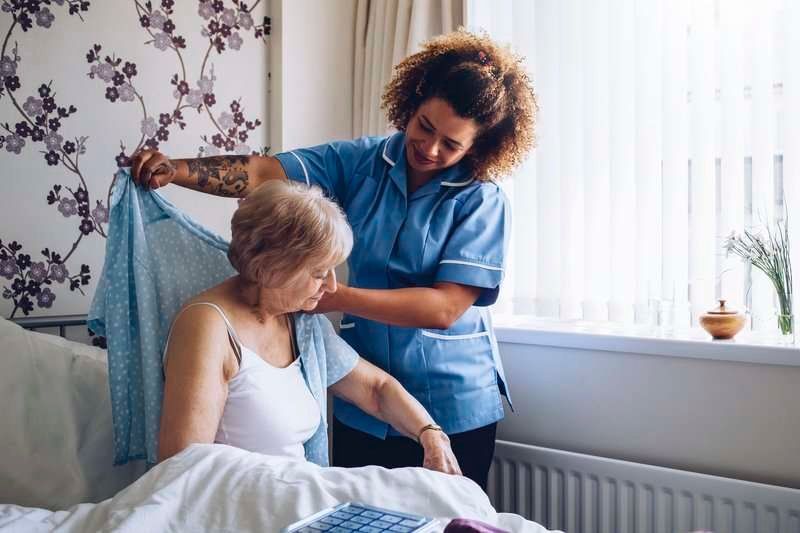
Three years ago, my mother-in-law (“Mom”) was hospitalized after she contracted a terrible strain of influenza. At the height of her illness, she had a stroke that left her with limited mobility and a loss of functioning on her right side. After a year of rehabilitation, Mom was able to move in with Grandma, who became Mom’s primary caregiver. This arrangement has worked well for a time, with Mom and Grandma mutually benefiting from companionship and emotional support.
However, as of late, Mom and Grandma have become increasingly irritated and disagreeable, both in their moods and in their interactions with one another. A few weeks ago, their grumpiness reached a fever pitch, and my husband and I were forced to intervene. After a heartfelt conversation with the pair, it appears as though their primary source of distress stems from Mom’s dressing and bathing routine. In essence, Mom has become resistant to accepting Grandma’s assistance with bathing, and Grandma has grown weary of strategizing ways to overcome Mom’s resistance.
If you are a caregiver who assists your loved one or client with his or her activities of daily living (ADLs), such as bathing, dressing, and grooming, you are not alone. In fact, according to the study Caregiving in the US 2015, one in four caregivers assists a loved one with ADLs. Moreover, caregivers, like Grandma, who assist a loved one with ADLs are inclined to experience higher levels of physical and psychological distress than caregivers who do not perform these types of caregiving tasks.
Caregiver Wellness U Model
Physical and psychological wellness are a part of the Caregiver Wellness: U model, a conceptual model that incorporates the movement toward social, psychological, physical, intellectual, spiritual, occupational, and financial wellness, while also incorporating the empowerment and resilience necessary to take charge of your health on a holistic basis. The components are not chronological; rather, they represent collective components.
What does it mean to be psychologically well? Being psychologically well means that you have adequate coping skills to deal with the sometimes-competing emotions associated with caring for your loved one or client.
What does it mean to be physically well? Physical wellness encompasses all the activities that keep you physically healthy as a caregiver. You are physically well if you exercise regularly, participate in physical activity without bodily pain, keep your blood pressure under control, abstain from smoking, eat a healthy diet and maintain a healthy weight, limit your alcohol consumption, and get adequate rest.
Tips for addressing the psychological aspects of bathing and personal care
The following are common challenges and suggested strategies to address your psychological wellness as you provide personal care for your loved one or client.
Identify the most significant source of your emotional distress. Is your greatest challenge associated with the guilt of being responsible for performing care? Thinking through Mom and Grandma’s situation brought me back to the time that I cared for my daughter. She was sixteen and suffering from a brain tumor. The medication she was taking made it unsafe for her to do anything alone for fear that she would fall. The bathroom was the least safe place for her to be alone so that it became necessary for me to continuously monitor her so that she could take a shower. It was such a distressing experience for us both. I remember my daughter saying, “Mom! I don’t want you to be in here with me.” With tears in my eyes, I replied, “I don’t want to be here, but it is not safe for you to be in here alone.” For my daughter, privacy was most important. However, her need for privacy was superseded by my need to keep her safe. You too may feel conflicted about not wanting to, but needing to, personally provide a bath or shower.
Suggested solution. My daughter’s need for supervised showering while temporary was necessary, and for a time we both had to put our emotional distress aside. We each expressed our frustration by discussing our mutual discomfort with her showers and came up with some strategies, such as pulling the curtain halfway closed so that she was somewhat shielded from my view. We also worked with the doctor by setting up a consult visit to have her medications adjusted. In the end, we found that her prescription was the source of her wobbliness. She ultimately had surgery to remove the tumor, and the medication was no longer needed. Talking to your loved one and sharing how you feel may open the door to improving your psychological well-being.
Is your loved one’s or client’s resistance related to a greater need for autonomy? There is almost nothing as personal as a bath. Mom, who is in her sixties, and who now must coordinate her bath schedule with her mother, may in fact feel as though she has lost control over her life. Mom’s distress may contribute her resistance with Grandma. In essence, Mom may be trying to exert some control in her life by refusing to cooperate with Grandma when she attempts to provide personal care.
Suggested solution. Dressing, bathing, and grooming independently are likely among the first tasks that you learned to do for yourself and being able to perform those tasks served to fortify your independence. One of the most important things you can do is to encourage and empower your loved one or client to do the tasks he or she can perform without assistance. Your goal is for your loved one or client to reach his or her highest level of practical functioning; you must relinquish some control so that your loved one or client can experience a level of autonomy.
Tips for addressing the physical logistics of bathing and personal care
A lack of physical support and feeling a loss of a sense of control have the potential to influence your attitude about assisting your loved one or client with personal care. In essence, experiencing bodily pain when providing personal care can be a contributing factor to the distress you feel. The following are tips to ease the physical distress associated with assisting your loved one or client with his or her ADLs.
Make sure your loved one’s or client’s bathing preferences are communicated and followed. It is important to garner your loved one’s or client’s preferences for bathing, including determining if a bed bath, partial bath, shower, or tub bath is the preferred approach. You and your loved one or client may also work together to set a bathing schedule that is mutually agreeable.
Make sure your loved one is not in pain or experiencing anxiety. Your loved one or client may be resistant to bathing when he or she is scared or experiencing pain. This may end up putting more strain on you. It is important to make sure your loved one or client is anxiety free and that he or she is not currently in pain prior to bathing.
Sitting rather than standing. If bathing your loved one or client results in bodily pain, you might find sitting rather than standing beneficial during your loved one’s or client’s bath or shower.
Enlist the support of an occupational therapist. You may find it helpful to set up an appointment with an occupational therapist, who can assist with environmental modifications or assistive devices so that your loved one or client has the ability to bathe with the least possible assistance.
Hire a professional bath aide. You may choose to delegate the bathing of your loved one to a bath aide. Bath aides are usually professionally trained and employed by a licensed home care company.
Assisting with ADLs is a very personal process. Most important is that you and your loved one or client continue to work together to avoid physical and psychological distress.