

Dr. Eboni Green
October 19, 2017

Khloe Kardashian may not immediately come to mind when you think of a caregiver. Yet, when her estranged husband had an unexpected life-threatening health crisis, she became his full-time caregiver. Like many caregivers, Khloe dropped everything and literally did not leave his side for weeks. Driven by worry, guilt, and the need to be selflessness, Khloe resisted taking time to make sure her needs were met and instead focused all her energy on her husband’s recovery. Months into her caregiving experience she hit a psychological brick wall and in a moment of emotional clarity Khloe said, “I just want to care for him, but I want someone to care about me too.” Fortunately, when she was finally ready to admit that she was exhausted, burned out, and that she could no longer go at it alone, her mother and sisters were by her side to provide her with the emotional support she needed. Khloe learned that being a selfless caregiver is neither realistic nor healthy long-term.
If you want to circumvent hitting an emotional brick wall, at full speed it is important to avoid always making the needs of your loved one a priority over everything, without taking time to nurture your psychological well-being.
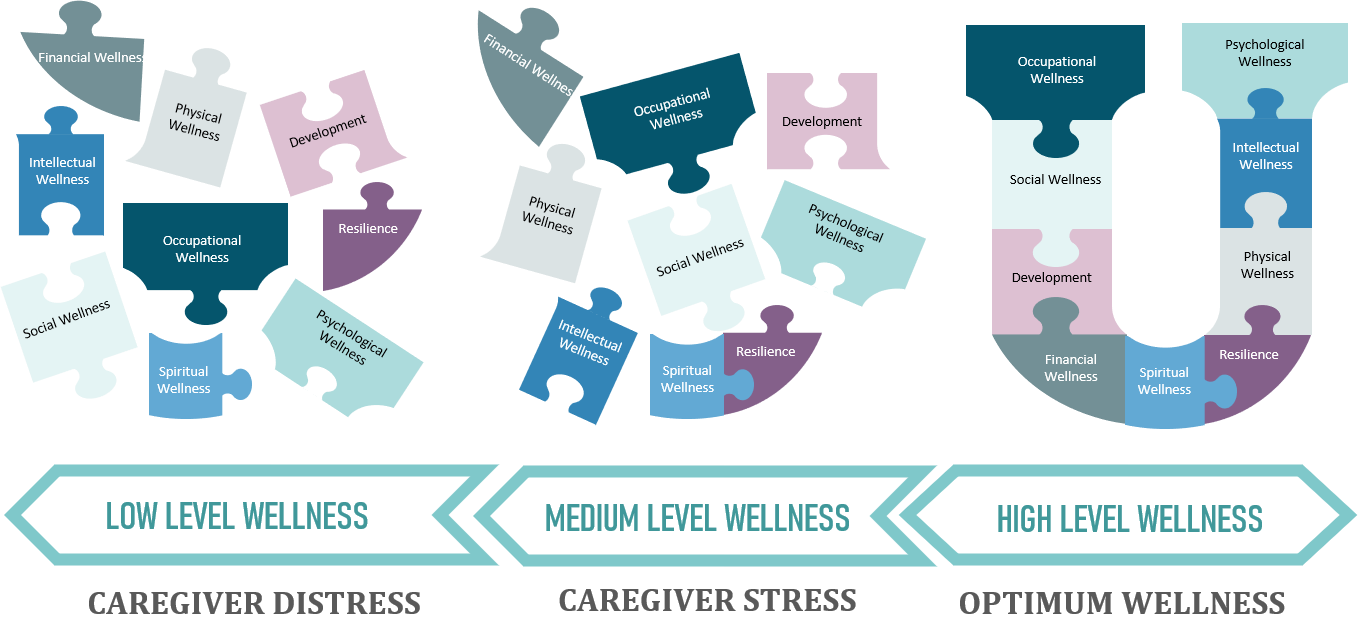
Psychological distress, in the context of caregiving, is a gradual process that is often the result of the unrelenting burden you may feel when it comes to providing care for a loved one. When you are psychologically distressed you do not know where to start to address your needs or the needs of your loved one. In fact, distress has been linked to increased mortality and deleterious health habits among caregivers (i.e., drinking, smoking, and eating an unhealthy diet).
Crying without knowing why. There is nothing wrong with crying. In fact, a good cry can provide you with the opportunity to release your emotions. However, crying without knowing the reason behind your tears can be a sign that you are psychologically distressed.
Feeling frustrated or shot-tempered all the time. Everyone experiences anger and feels frustrated sometimes. However, if you find that you are short-tempered or angry all the time you are displacing your emotions. When you do not address how you are feeling you increase the chance that you will burn out.
Ineffectively communicating with family and friends. Ineffective communication is often the first sign that you are distressed. This is partially because when you are burned out your brain is overloaded. You need a clear mind if you want to effectively express your feelings.
Feeling hopeless or feeling that you have little control over your life. Caring for a loved one can exacerbate the feelings of isolation, hopelessness, and helplessness. The emotional demands of providing care can be tremendous and you may end up feeling that you have less control over your life.
Not sleeping through the night. One of the fastest ways to burn out is to get inadequate rest. Without proper sleep you will soon find that your energy is depleted. Worrying and sleep deprivation can also cloud your thoughts.
So how do you avoid burning out? One crucial step is to first recognize that you are psychologically distressed and then work towards taking steps to improve your well-being.
Psychological wellness refers to your ability to cope with stress, depression, anger, grief, and anxiety; to problem solve; and to communicate effectively with family, friends, and the rest of the health care team. The following are three resources that may help you to put the focus back on you so that you can improve your psychological wellness as a caregiver:
Print out Your Portable Guide to Stress Relief, a valuable resource published by Harvard Health Publications. Included in the guide are quick tips for managing your stress in the workplace. The suggested activities can be performed during your scheduled work breaks or at other times when you are feeling stressed.
Listen to the pre-recorded Caregiver Wellness: Power of U web seminar designed to help family and professional caregivers manage stress associated with caring for a client or loved one. You will learn to use the “Caregiver Wellness: U Model” to develop social, psychological, physical, intellectual, spiritual, occupational, and financial wellness and cultivate empowerment and resilience.
Create a Caregiver Action Plan so that you can focus on helping your loved one rather than rescuing. One of the most important concepts you can grasp as a caregiver is help rather than rescue. Helping means you provide needed assistance yet encourage your loved ones to do what they can for themselves. From a caregiving perspective helping is a strategy for self-preservation. For example, if your loved one needs assistance with getting to doctor’s appointments, meal preparation, and companionship you arrange those services. Then you encourage your loved one to do what they can do for themselves and preserve your energy so that you are only performing pertinent tasks. Please use the Caregiver Action Plan tool to guide you through the steps for creating your personal plan.
Psychological distress often leads to burnout. Therefore, it is imperative that you care for yourself so that you can avoid the dark alley of distress. Remember that you cannot be everything to everyone else and nothing to yourself.
What do you do to prevent becoming psychologically distressed while caring for someone you love? Have you ever felt that you were on the verge of burning out? What strategies do you think are most effective when trying to avoid burning out?